
Reading Marion County Property Tax Records
Property tax records in Marion County live in two places. The Assessor keeps the valuation card for each parcel. The Sheriff keeps the tax account itself. Marion County property tax records from the Assessor show the land and building. They also show the total appraisal fields. The Sheriff's side covers the taxpayer and the tax year. It covers the ticket and whether a bill is paid. These numbers answer different questions than a deed or a sale price would. You can search Marion County property tax records by address or parcel key. Then confirm current notices and exemptions with the office that administers them.
| Field | What It Shows | Where |
|---|---|---|
| Land / building / total appraisal | Separate property value fields on the assessment record | Marion County Assessor |
| Assessed value | Generally 60% of true and actual value under state law | Assessor record and assessment rules |
| Taxpayer / account | Identifies the bill account used for a property | Sheriff Tax Office inquiry |
| Year / ticket | Tax period and bill reference | Sheriff Tax Office inquiry |
| Paid / unpaid | Payment-status field shown in the inquiry | Sheriff Tax Office inquiry |
An assessed amount is not a sale price. The assessor's true-and-actual value basis, exemptions, and any tax bill that follows are their own figures. And if a tax inquiry still displays data while online payment is down, treat that status as a separate question. Confirm it with the Sheriff.
Marion County Sheriff Tax Inquiry Fields
The Sheriff's online tax inquiry takes several search keys. Taxpayer name, account, and year or ticket are the first tier. District, map, parcel, and subparcel fields follow, along with tax year, property type, and paid or unpaid status. It stands apart from the Assessor's search as its own tool. Sometimes the name on a bill differs from the current parcel-card owner. A county account number or full map identifier is then the strongest bridge between the two systems. The inquiry page also warns that payment availability can change. The data may stay viewable while that happens. A screen result is a snapshot. Save the tax year and ticket number, and call the Sheriff before making a payment or relying on any delinquency status.
Marion County’s 60 Percent Assessment Level
W. Va. Code §11-3-1 sets annual property assessment as of July 1 at 60% of true and actual value. The Tax Commissioner also describes county appraisals under the statewide valuation system, with special treatment for farmland and managed timberland. This statutory relationship explains why assessed value is not a sale price.
Compare land appraisal, building appraisal, total appraisal, and assessed amount as separate fields. A recorded sale may appear in the sales history but is not a promise that the next assessment will equal the last consideration amount. Ask the Assessor about the exact card year and any special valuation applied to a parcel.
Assessment Increase Notices in Marion County
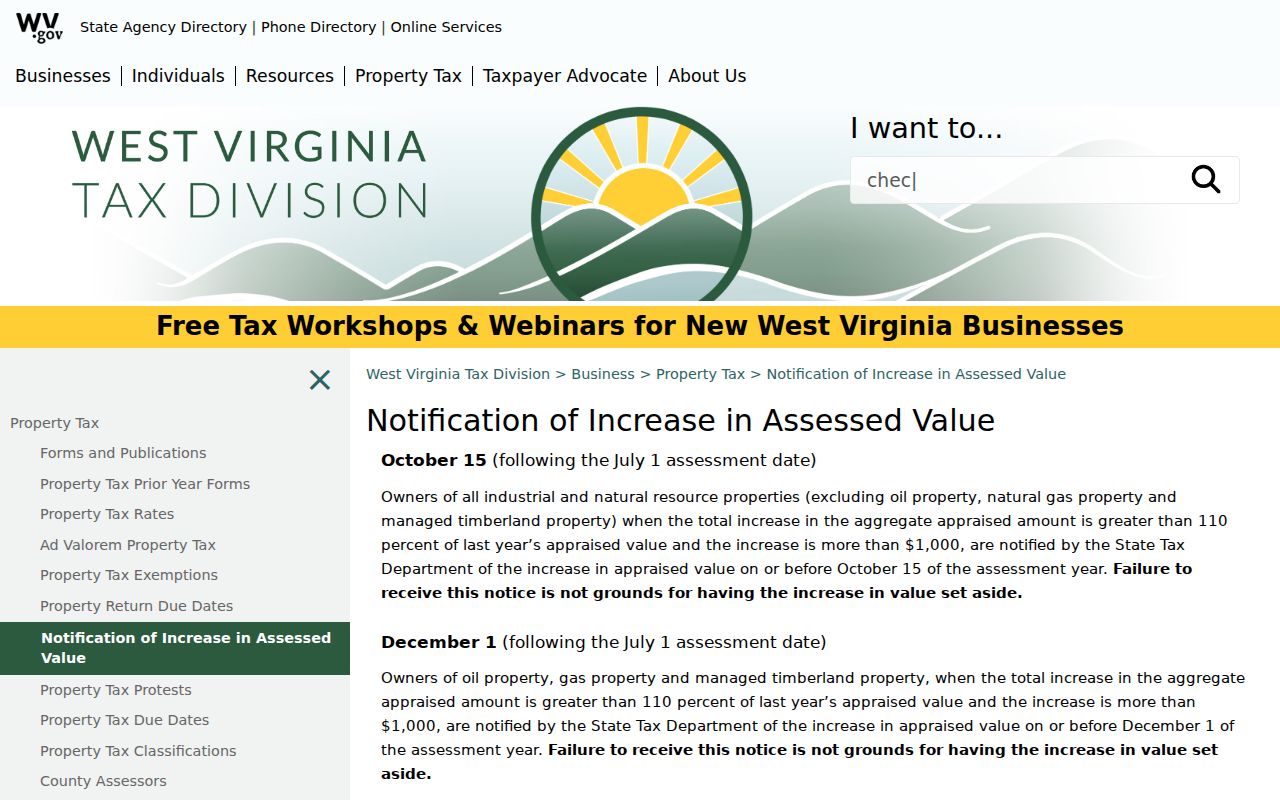
State guidance requires a notice by January 15 whenever an assessed increase exceeds 10% and is at least $1,000. There are exceptions for certain state-appraised property. That trigger is a notice rule only. It does not replace the local appeal calendar, so Marion taxpayers should ask the Assessor for the current Board of Equalization and Review dates and filing materials before a deadline nears. The West Virginia Tax Division notice guidance explains the details.
Keep the notice on hand. Comparing it with the prior and current assessment cards gives the Board of Equalization and Review a clearer picture when it reviews a value.
Marion County Delinquent Tax Route
Delinquent taxes in Marion County run through several offices. The County Clerk records trustees' reports of sale for foreclosures. The Sheriff maintains the tax inquiry itself. A 2021 county taxpayer notice explained that Senate Bill 552 shifted delinquent real-estate tax-lien sales. Those sales went to the State Auditor. Under that notice, the Sheriff certifies delinquent properties after October 31. Later sale and redemption are handled by the Auditor. That notice concerns a prior tax year. Verify the current schedule and Marion list with the State Auditor. Use the Sheriff inquiry to identify the account and tax year. Then check the Auditor's current delinquent-land instructions. Also check the County Clerk for any recorded report, deed, or release.
Marion County Exemptions and Special Values
Marion County publishes no complete current list of exemptions or application calendar. The state does offer special valuation for farmland and managed timberland. Never assume an exemption from an owner label or an old tax bill alone. Ask the Assessor which eligibility rules and forms apply to the parcel and tax year. For a record not online, send a written request to the Assessor or Sheriff. The request should identify the account, map/parcel, tax period, and document sought. Under W. Va. Code §29B-1-3, the public body must respond within the statutory maximum period. It may charge actual reproduction cost.
Find a Marion County Tax Bill
The Sheriff inquiry searches by taxpayer, account, year or ticket, or district/map/parcel/subparcel. Start with the account number from the Assessor card when you have it; that cuts confusion when a street address or owner name has changed. Then pick the tax year and the real or personal property path that fits the bill.
- Open the Marion Sheriff tax inquiry and search by taxpayer, account, year/ticket, or district-map-parcel-subparcel.
- Choose the tax year and real or personal property option, then note whether the account is paid or unpaid.
- Compare parcel and owner details with the Assessor card; do not infer a tax year from a current-value field.
- For delinquency or redemption questions, confirm the current route with the Sheriff or State Auditor.
- Assessed value
- The assessment amount set under the state valuation system, generally 60% of true and actual value.
- Levy
- A taxing charge applied through the relevant tax calculation; confirm Marion’s current district figures with the custodian.
- Homestead exemption
- A property-tax reduction associated with an eligible residence; current Marion eligibility and application details should be confirmed with the Assessor.
- Tax lien
- A claim tied to unpaid tax; the current sale and redemption process should be checked with the State Auditor.
Match the Marion County Tax Ticket to the Parcel
The Sheriff's tax inquiry is built around a few key fields: taxpayer, account, year, ticket, district, map, parcel, subparcel, and property class. A name alone often fails here. One owner can hold several parcels, and one account can span multiple billing periods. Keep the tax year and ticket beside the account number so any paid or unpaid status is read against the right cycle.
The portal sometimes shows tax information for a record it cannot take payment on. Treat the screen as an inquiry result. For a balance, a receipt, or current collection procedure, contact the Sheriff's Tax Office directly. A tax status proves neither ownership nor a lien release; those questions belong to the County Clerk's recorded deed records and release instruments.
Real-property and personal-property accounts sit apart in the system. Pick the class that matches the bill. If an online display and a paper receipt disagree, give the Tax Office the ticket number and tax year rather than a parcel map or a later account.
Delinquent collection takes extra care. A 2021 county notice reported that Senate Bill 552 moved tax-lien sales to the State Auditor after the Sheriff certifies delinquent accounts following October 31. That notice is historical guidance only. Ask the Sheriff which year's process governs your parcel, and verify sale or redemption details with the State Auditor before paying anything.
Some parcels carry farmland or managed-timberland valuation rather than an ordinary residential card. Ask the Assessor which use classification is recorded and what application or renewal applies. Special valuation ties to classification and tax year, so do not compare it straight across a house parcel without reading the land and building fields first.
An unpaid ticket? Keep the year and ticket number with the account, then ask the Sheriff for the payoff and accepted payment methods. A paid ticket deserves the same discipline. Retain the receipt and confirm it covers the same year and parcel. A displayed status is not a receipt or a release instrument.
Assessment and billing answer different questions. State practice values property each July 1 at 60 percent of true and actual value; the ticket then applies the year, account, and class. A valuation dispute is an assessment appeal. A balance question belongs to the Sheriff's Tax Office. Bring both cards, the notice, the ticket, and any receipt, and ask the custodian which record is actually under review.
Appeal a Marion County Assessment
West Virginia assesses property each July 1. The standard is 60 percent of true and actual value. Big jumps trigger notice. When an assessed value rises more than 10 percent and at least $1,000, state guidance requires notice by January 15. That rule bends only if a general increase is published. A taxpayer may then appear before the county Board of Equalization and Review. Marion County posts no current meeting dates or filing form online. Confirm both with the Assessor.
Appeal window. The January 15 notice rule applies to a qualifying increase; it is not a published Marion hearing date. Ask the Assessor for the current Board of Equalization and Review calendar and preserve the notice, current and prior cards, photos, and comparable sale evidence.