
Start a Marion County Property Search
The Marion County Assessor lets you combine search criteria freely. A street address or owner name will pull up the parcel card. An account number or district, map, and parcel pieces narrow the match. Legal description and deed book/page work well when the street label is old or unclear. One convention matters: type owner names LAST NAME FIRST NAME, with no commas. This search is the fastest way to gather identifiers for the next office.
Write down the exact owner spelling, account, full parcel number, legal description, and deed reference as you go. Viewing the Assessor search is free, though coverage depth and image access are not stated. A blank row means missing data or a mismatched input. It does not prove that a deed or tax parcel is absent.
- Search the Marion County Assessor by street address or surname-first owner name.
- Open the parcel card and copy its account number, legal description, map/parcel, and deed book/page.
- Check the Sheriff’s tax inquiry using the account or district/map/parcel/subparcel.
- Open the WV Property Viewer with the physical E-911 address or full parcel identifier.
- Ask the Marion County Clerk for the recorded deed or instrument when a copy is needed.
Inside a Marion County Property Search Result
A Marion County Assessor parcel card labels the current owner, mailing address, street address, legal description, account number, deed book/page, sales history, and assessment record. The WV Property Viewer adds parcel geometry, community, property class, E-911 address, flood information, building details, and a GIS ID. One caution: a result list may name only one of several owners.
| Current owner | Name shown on the assessor tax roll; it may lag a recorded transfer |
|---|---|
| Street / mailing address | Physical location and owner mailing address are separate fields |
| Account / parcel ID | County account and district-map-parcel-suffix key |
| Assessment record | Land, building, and total appraisal values; not an appraisal certificate |
| Legal description | Lot/block or metes-and-bounds text tied to the land |
| Deed book/page | Reference for a recorded instrument in the Clerk’s index |
No card or map reports every lien, exception, easement, co-owner, or pending update. For Marion County due diligence, match the legal description to the deed, then check releases, tax status, and any relevant court file. The record is a starting point. It is not a title search or a boundary determination.
Choose a Marion County Search Key
Choose the key that fits what you already hold. Use the address when you know the physical site, the owner name when you do not, and the parcel ID when another record supplies the number. Marion County's statewide GIS source relies on E-911 physical addresses, not rural routes or post-office boxes. A postal label and the situs address can differ. If an address search fails, try the parcel number.
| Search Key | Best For | Where It Works | Watch Out |
|---|---|---|---|
| Address | Locate one physical property | Assessor or WV Property Viewer | E-911 format; no rural-route or P.O. Box search |
| Owner name | Find a card tied to a person or entity | Assessor; Clerk index for a deed party | Last name first, no comma; entities and estates vary |
| Parcel ID | Match one land tax parcel across systems | Assessor, Sheriff inquiry, WV Viewer | Preserve leading zeroes and all suffix parts |
Not a title search. A Marion County property search shows indexed or assessed data, not every claim or legal issue affecting title. A title company or attorney must examine the full record for that purpose.
Marion County Assessor Search Fields
The county form takes an optional owner name, parcel address, account number, district, map/parcel pieces, property type, legal description, and deed book/page. You can combine these fields in any way. Owner names follow one convention: LAST NAME FIRST NAME, no commas. Exact matching behavior for each text box is not stated. The Marion County Assessor search form displays those fields together.
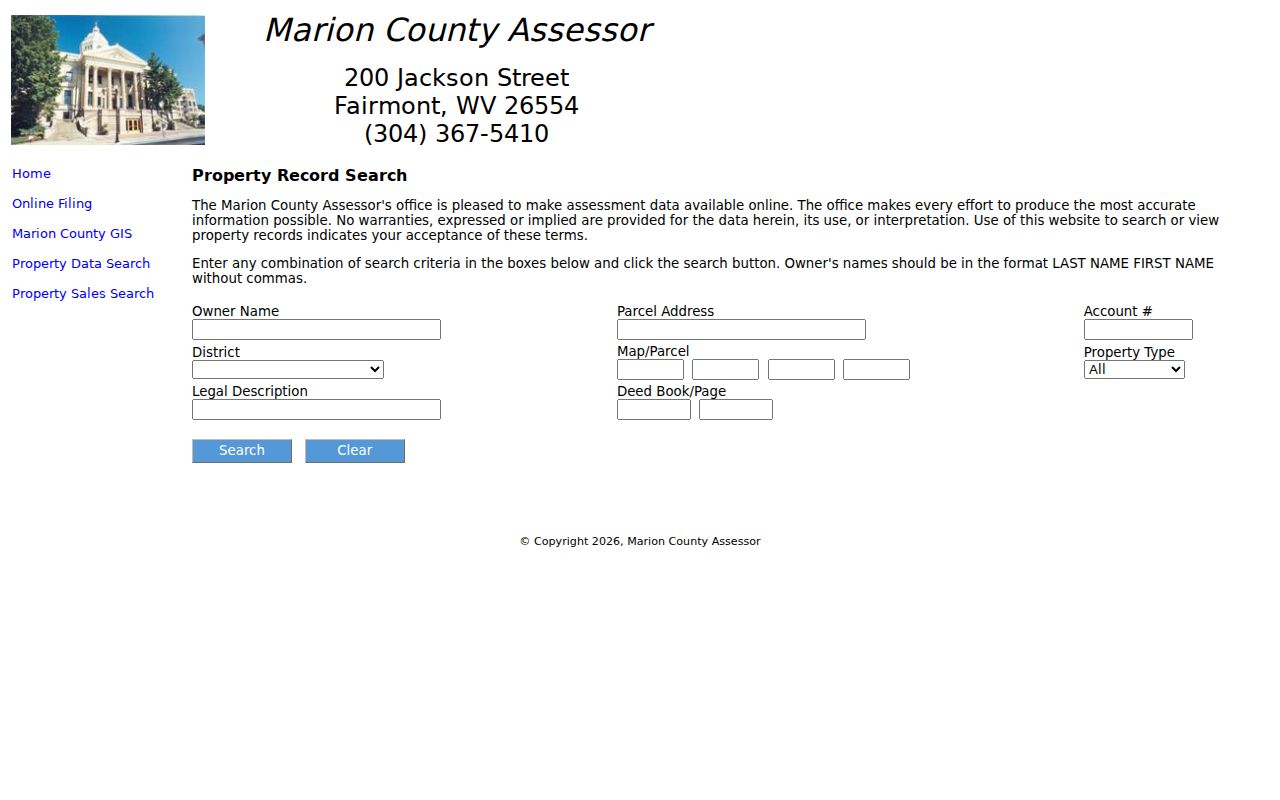
A search that returns no row is not the end. Keep the parcel clues and try a second key rather than assuming the property has no assessment record.
Marion County E-911 Address Matching
The statewide viewer searches by a physical E-911 street address. A rural route or post-office box will not work as the property location. Enter street, city, and state. Then confirm the returned polygon and street label fit the parcel you are researching.
A mailing address on a tax card can sit outside the parcel's city or ZIP. When an old deed carries a prior street name, keep that wording. Try the owner, legal description, account, or parcel number in the Assessor instead. Marion County spans incorporated places and rural communities alike. A postal city proves nothing about municipal jurisdiction.
Read a Marion County Parcel ID
West Virginia's IAS identifier has four parts. It combines a two-digit district, a four-digit map number, a four-digit parcel number, and a four-digit suffix, keeping every leading zero. Statewide data may also show a special parcel segment. Copy the full ID from the card. Shortening it to map and parcel invites errors.
That one number ties the Assessor card to the Sheriff's tax inquiry and the WV Property Viewer. The statewide data specification keeps owner mailing fields separate from physical-address fields. Drop the zeros or leave off the suffix, and two related Marion County records can look like a false mismatch.
Marion County Viewer Details and Exports
The WV Property Viewer returns a map plus an attribute result. Its detail panel can list one or more owners, physical address, property class, and legal description. It can also show community, E-911 address, flood information, building details, cost values, and appraised values. The result list may show a single owner even when the detail record holds more.
Results export as CSV. Users can build a shareable map link or open a KMZ download for a chosen parcel. These options preserve a search result for later comparison. The viewer notes that the county assessor supplies the property attributes. Parcel changes may wait on state processing.
Marion County Owner-Name Variants
The Assessor's surname-first format is a helpful starting point. It does not guarantee uniform spelling, however. One deed may involve a spouse, trustee, personal representative, company, or estate. Start with the name shown on the current card. Then test variations. Try initials, middle names, suffixes, and punctuation. Try estate wording, too, whenever a transfer seems missing from the Marion County property records.
Never merge people who simply share a last name. Check the parcel's legal description. Check the book and page, account, and co-grantee as well. Only then treat a result as the true owner of record. When an LLC holds the land, state entity records can clarify the business name. The recorded deed still remains the authoritative transfer record in the deed records.
When a Marion County Search Finds No Row
Start by normalizing the address itself. Drop the apartment unit. Try the E-911 street form. Treat a route number only as a clue. When the tract is vacant, fall back on the owner or the legal description. You can also use a map or parcel number, an account, or a deed book and page. The county form takes several criteria at once. The statewide WV Assessment search adds street-name and prior-ownership modes.
If no row comes back, the cause could be simple formatting. It might be a recent split or merger, a stale map layer, or an index gap. The record may still sit only in a book or file. The county publishes no Marion-specific live street-wide sample. It states no live deed-index cutoff either. Keep those limits in view when comparing searches.
Marion County Counter and Request Routes
Visit the Assessor at 200 Jackson Street or call 304-367-5410 about an assessment card. The County Clerk's official directory lists 219 Adams Street, P.O. Box 1267, Fairmont, and 304-367-5445. The Sheriff's Tax Office runs an online tax inquiry. Its page notes that viewing may still work when online payment is down, so check a tax bill even if payment fails.
For any record not exposed online, ask the custodian directly for inspection or a copy. Under W. Va. Code §29B-1-3, a focused FOIA request should describe the address or parcel, the record type, the date range, and the format you want. The fee rule permits charging actual reproduction cost. Confirm certification or mailing charges with the office, since no deed-image fee schedule is published.
Keep the Marion County Search Result and Its Keys Together
A single Marion County result carries several keys. Write down the address exactly as typed. Record the account number, the district and map or parcel, and the deed book and page. Each key opens a different door. The account number belongs to the assessment and tax roll. The deed book and page points to a recorded instrument. The legal description confirms you are looking at the right land. Save them together. If a later search behaves differently, the full set of identifiers makes the record easy to recover.
The Assessor portal accepts several search combinations. The precise matching logic is not documented, and not every displayed field may be indexed. When a broad query returns several results, narrow it with a second identifier you already know. Compare the physical address, owner field, and legal description before settling on one. Got nothing back? Keep the leading zeroes in the parcel ID. Try the account number or a shorter address form. Remember that a no-result screen does not prove the property has no county record.
Keep the physical location apart from the mailing destination. A rural property may carry an E-911 address different from a rural route or a post-office box. The statewide viewer does not accept every postal description as a map location. When the assessor result shows a street address, test it in the viewer. Compare the selected parcel's full identifier. Do not rely on the owner name alone. The viewer can display a single owner line even when another county card lists fuller ownership.
A good saved note records the address wording and the owner-name format. Include the account, the parcel ID, the deed reference, and which portal or map you used. Parcels get split, combined, or renumbered. When that happens, compare the current card against the older legal description and the recorded plat. County assessment data, Clerk instruments, and state GIS do not always update at the same moment. For corrections, the Assessor is the county contact for tax-parcel data. For a title or lot-layout question, request the deed or plat from the Clerk.
Owner searches in Marion County follow a stated format: LAST NAME FIRST NAME, with no comma. Keep alternative name forms separate. A former surname, a middle initial, a trust name, or an entity suffix can each change what appears. The portal documents no complete fuzzy-matching rule. Before selecting a familiar name from a list, use the return's account and legal description. Confirm the match belongs to the intended parcel.
For address searches, start with the physical street spelling shown on the parcel card. If the full unit or directional suffix is not recognized, try a shorter street form. Then compare any result against the map and card fields. A saved note of a failed query proves only that one query, not the portal's limits. The index depth, exact-match behavior, and any result cap are not documented.
Older search keys still work. A book and page reference from a prior deed or a tax bill helps locate the recorded instrument. The account number and full parcel ID serve assessment and tax systems better. Never swap one key for another in your notes. If a deed names a lot or subdivision while the Assessor assigns a newer parcel number, keep both references. The Clerk or Assessor can say which one a specific record request requires.