
The Marion County Owner-of-Record Card
The Assessor's parcel card is the tax-roll view of Marion County ownership. It pairs the owner with address and land-reference details. Start there. The name attached to an account appears clearly. Still, a quick card view cannot prove that no later deed was filed, or that every co-owner shows up in a short summary.
| CURRENT OWNER | Name or entity shown on the Assessor card |
|---|---|
| MAILING ADDRESS | Address tied to owner correspondence |
| STREET ADDRESS | Physical location of the parcel |
| ACCOUNT NUMBER | County account identifier |
| DEED BOOK/PAGE | Recorded reference to check with the County Clerk |
| SALES HISTORY | Assessment-card history; live sample row was not captured |
The owner of record may not live there. Tax notices go to the mailing line. That line shows where correspondence is sent in Marion County, not who occupies the property, so keep the distinction firm when reading a current owner record.
Confirm the Latest Marion County Owner
Confirmation takes two records. Match the Assessor card to the most recent recorded deed for the same legal description in Marion County. A sale can reach the County Clerk first. The tax roll catches up later. Marion County publishes no fixed refresh interval for the current owner field, so a card's age should never be converted into a precise number of days.
- Copy CURRENT OWNER, account, legal description, deed book/page, and sales-history fields from the card.
- Ask the County Clerk for the latest deed into that owner and compare its grantee and legal description.
- Check whether an estate, trust, or entity appears as the named grantee; use its own records as context.
- Record the mailing address separately from the physical property address.
- Owner of record
- The name or entity displayed in the assessment record.
- Assessment roll
- The Assessor’s tax record for a parcel and account.
- Situs address
- The physical location, separate from owner mailing address.
The Marion County CURRENT OWNER Label
The Marion County parcel card carries a fixed set of labels: CURRENT OWNER, MAILING ADDRESS, STREET ADDRESS, LEGAL DESCRIPTION, ACCOUNT NUMBER, DEED BOOK/PAGE, SALES HISTORY, and ASSESSMENT RECORD. The labels are the map. Values are another matter. The sample endpoint returns those fields without a populated result row, so no parcel should be expected to fill every line. The Marion County assessor-card view shows the same layout.
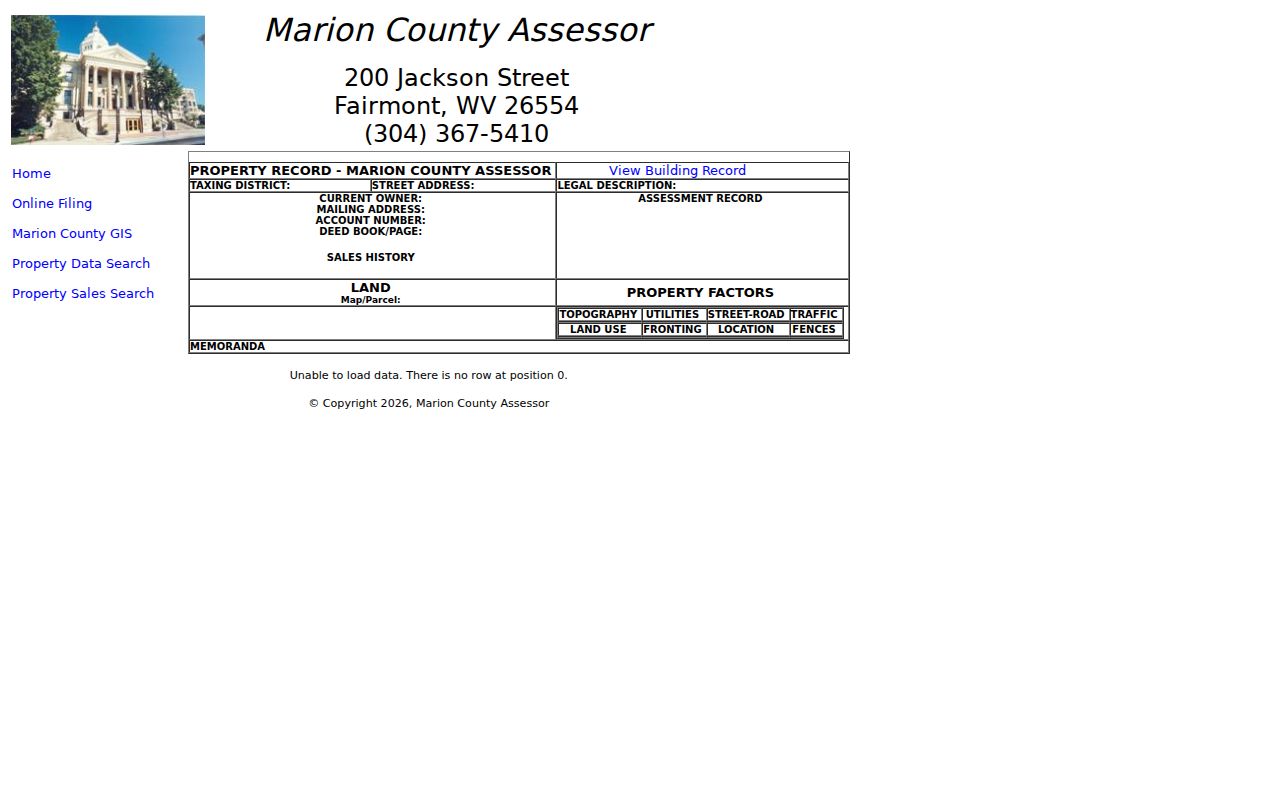
Copy the card's exact names and deed reference first.
Marion County Mailing and Street Addresses
Marion County's card separates MAILING ADDRESS from STREET ADDRESS. State parcel data does the same. It splits the owner's mailing fields from the physical parcel address. A mailing address outside Fairmont moves nothing. The situs address is the point to compare with the GIS viewer and the municipal map.
The split also explains a common puzzle. A tax notice can travel to a different place from the building it concerns. Keep both addresses in your notes, and never substitute the owner's correspondence address when checking where a deed, zoning file, or parcel polygon applies.
Co-Owners on Marion County Records
A WV Property Viewer result list can show a single owner. The detailed record may hold more names. The Assessor card's exact owner lines are a better check. So are the deed's grantees. When a spouse, trust, or business name appears with another party, compare the account number and legal description before drawing conclusions. Never assume the displayed person holds the only interest. An owner-name search is only a route to a record, while the deed states the parties and land description filed for that Marion County transfer.
Recent Marion County Deeds and Roll Lag
Marion County publishes no set interval for updating the current owner field after a deed. The lag is real anyway. A recently recorded grantee can appear in the Clerk's record while the Assessor card still shows the prior name. Check the recording date first. Then contact the Assessor with the account number and deed book and page. That detail moves the question along. The Marion County owner-finding route covers the broader method. The current-owner check is narrower: match today's card to the newest filed deed, and keep the situs and mailing addresses distinct in Marion County.
Marion County Owner Record Access
Start with the Assessor’s free online property search. The office sits at 200 Jackson Street, Fairmont, WV 26554, and answers the phone at 304-367-5410. For a recorded confirmation of ownership, the County Clerk directory lists 219 Adams Street, P.O. Box 1267, Fairmont, WV 26555, phone 304-367-5445. Call ahead to confirm counter arrangements before you travel.
Records not exposed online can still be requested from the custodian. Provide the parcel account, the deed reference, the names involved, and a date range. No deed-copy or assessor-card copy fee is published, so ask the office about costs before ordering.
Read the Marion County Owner Field with Its Record Date
The owner name on a parcel card is the tax roll's current display. A deed works differently. It carries its own recording date and legal description. After a sale, records update on different schedules. Timing explains most surprises here. Compare the deed book and page against the latest recorded instrument. Check the assessment period on the card as well. Only then treat a mismatch as a possible error, since a recently recorded transfer may not yet appear in every tax or map layer.
Multiple owners or an entity call for careful copying. Print the names exactly as the source shows them. The card may abbreviate a name or show a mailing address for one contact even when the property interest is shared. That distinction matters. A legal ownership question needs the recorded conveyance plus any later instrument affecting the interest. The display label alone settles nothing about co-ownership, trust authority, or an estate's status.
The Assessor's parcel card gathers a useful cluster of fields in one view: current owner, mailing address, street address, legal description, account number, deed book and page, sales history, and the assessment record. One caution applies. The sample endpoint can display labels without returning a populated record. So a blank or absent item is not proof that the underlying event never occurred. When spelling is uncertain, search by several identifiers.
For a recent transfer, confirm the grantee and legal description on the instrument fit the same parcel before treating the roll as current. Updates can lag after recording. The map, bill, and assessment card rarely change in step. Give each layer time. Where the property is divided among co-owners or conveyed to an entity, keep every name exactly as printed and ask the Clerk for subsequent recorded instruments. A property owner lookup is a dated view of county records. It is not a real-time guarantee of possession or authority to act for an entity.
The state parcel viewer confirms location well. It may show only one owner name, though. The County Assessor's parcel card is richer for local cross-checking, because it can include mailing and street addresses, the account, legal description, deed book and page, sales history, and assessment data. Treat the sample endpoint's labels as possible fields. They do not promise every account holds every item.
If a name or parcel number changes, record both identifiers. Note the old and the new. Ask whether a split, merger, or later conveyance explains it. A deed can be recorded before the assessment roll or mapping layer reflects it. Formal ownership questions belong to the instrument and later filings in the Clerk's record; current tax-roll questions belong to the Assessor, who can explain the card's year and update status.
A mailing address is not the physical site address. Neither alone proves who occupies or controls a property. For matching a displayed name to the right parcel, the account's legal description and deed reference are better keys. Ownership can sit with an estate, a trust, or several co-owners. Later deeds, releases, assignments, or probate-related records may be needed to understand the recorded interest in those cases. Read the chain, not just the label.
Marion County Owner Contact and Limits
The tax card's mailing address is a contact clue. It is not an invitation to intrude. The Safe at Home program offers a designated address to eligible participants. West Virginia runs it, and the Attorney General's office sets current eligibility and application rules. If a lookup raises a safety or privacy concern, lean on the program and custodian guidance. Do not bypass a protected address.
Lawful use. Use the owner record for a legitimate property, tax, or civic matter. Do not use it to stalk, threaten, or harass anyone.