
Find Who Owns a Marion County Property
An address search at the Marion County Assessor is the cleanest start. Copy the CURRENT OWNER spelling exactly. Grab the account number, deed book/page, and legal description too. The GIS Viewer adds parcel ID and address context, but its result list may show one owner only. Treat that first match as provisional until the latest County Clerk deed names the recorded grantee.
Without an address, search by owner name. The Assessor wants LAST NAME FIRST, no commas. Run the spelling variants carefully. Then compare the account and legal description across hits. Joining a tax card to a filed instrument answers who owns it, but that will not catch hidden beneficial owners behind an entity.
- Search the Marion County Assessor by the situs address, account, parcel ID, or owner name.
- Open the card and record every owner line, mailing address, legal description, and deed reference.
- Use the County Clerk’s recorded deed category to confirm the latest grantor and grantee.
- If a company appears, search West Virginia Business & Licensing for entity details, then keep the deed as the land record.
Marion County Property Owner Sources
Different Marion County records name owners for different reasons. The Assessor keeps the CURRENT OWNER tax-roll field and the mailing address. The County Clerk files the deed and its parties. A Sheriff tax inquiry keys on the taxpayer or parcel account. The statewide GIS panel can display one owner name. It can also display more than one owner name right on the mapped property.
| Source | Owner Info It Gives | Access |
|---|---|---|
| Assessor card | Current owner display, mailing and street addresses | Free county search |
| County Clerk deed | Grantor, grantee, legal description, recorded reference | Directory and custodian access |
| Sheriff tax inquiry | Taxpayer, account, tax year, paid/unpaid status | Online view and Sheriff contact |
| WV Property Viewer | GIS parcel, owner display, physical address, detail fields | Free statewide map |
The owner of record is not always the occupant. The mailing address may sit in another city entirely. Treat the tax-roll name as a lead, then check the deed and legal description before drawing any ownership conclusion.
The Marion County CURRENT OWNER Field
The Marion Assessor parcel card keeps its fields plainly labeled. CURRENT OWNER sits alongside MAILING ADDRESS, STREET ADDRESS, ACCOUNT NUMBER, LEGAL DESCRIPTION, DEED BOOK/PAGE, and SALES HISTORY. ASSESSMENT RECORD sits alongside them too. That owner field is the fastest first lookup. No set update interval after a transfer is published. The Marion County parcel-card page displays the same field names for any record match.
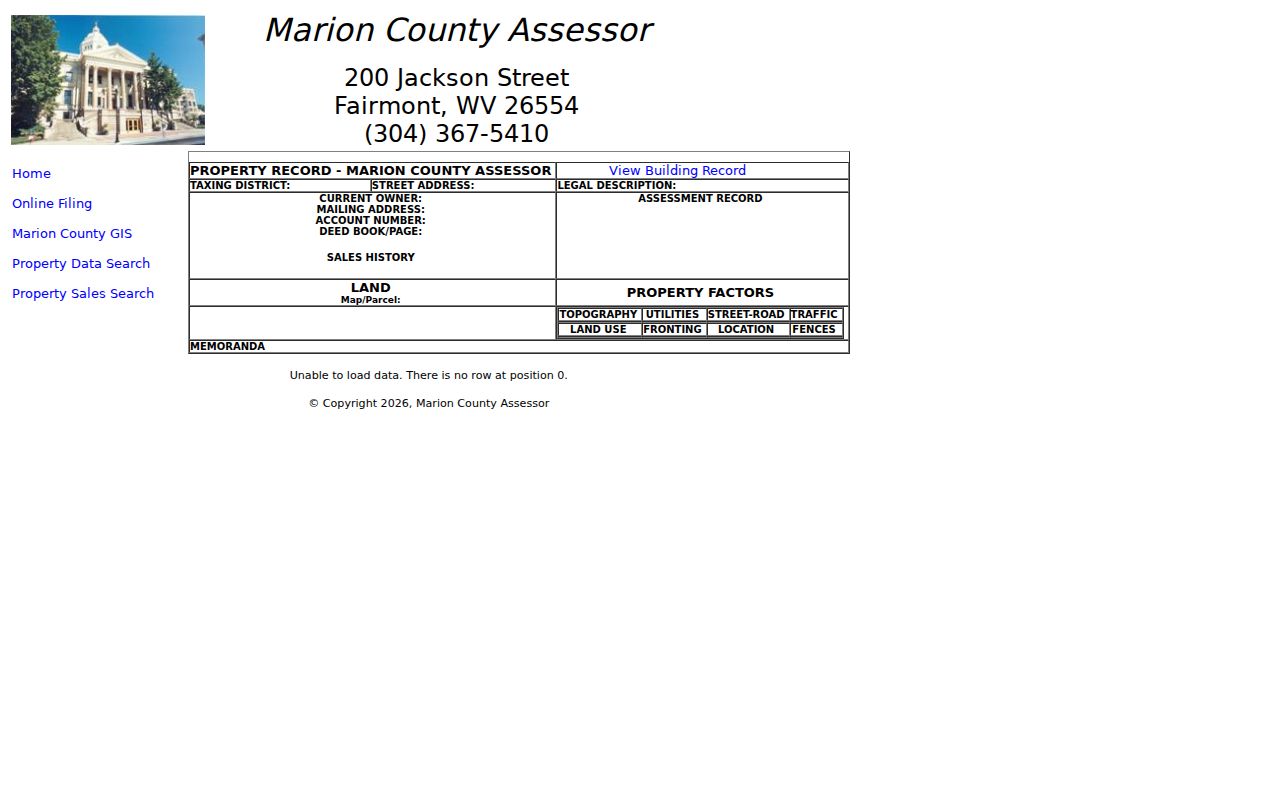
Read every owner line closely. Compare the street and mailing locations before carrying the name over to the County Clerk index.
Confirm the Marion County Deed
The latest recorded deed is the confirmation step. It names the parties and the legal description filed with the County Clerk. The Clerk's online page lists land-record categories. It gives no live index fields. It offers no online start year. There are no image access details and no fee schedule. Plan to request the instrument directly.
Bring the account, book/page, grantor, grantee, and full legal description to 219 Adams Street. You can also mail a written request. For tracing owners backward, use the deed-record search method. This lookup ends once the tax-roll name matches a filed conveyance.
Marion County LLC, Trust, and Estate Owners
A parcel card may name an LLC, trustee, personal representative, or an estate instead of an individual. West Virginia Business & Licensing can help here. It exposes an entity's filed name and registered-agent details where the public form shows them. It is no substitute for the deed, though. Nor will it disclose every beneficial owner.
For a deceased owner, compare the County Clerk's personal representative's deed or heir conveyance with Circuit Clerk probate records covering appointment, authority, and orders. A will can explain the estate path without being the instrument that updates land ownership. Keep the legal description as your anchor.
Mailing Address Versus Marion County Situs
The mailing address tells the county where to send tax correspondence. The street or situs address pins down the physical parcel. State parcel data keeps those in separate fields. The two can point to different cities or ZIP codes. That does not change which tract the account describes.
The WV Property Viewer has a quirk worth knowing. Its short result list can show one owner while the detailed record lists more. So compare the full card and legal description. A summary row is never the complete owner list. An owner's mailing address is no substitute for the property location.
Recent Marion County Owner Changes
A new deed can be recorded before the Assessor's CURRENT OWNER field catches up. The county publishes no roll refresh interval. Never assign a firm number of days to the lag. When the card and the deed differ, note each date. Ask the Assessor whether the tax roll has processed the transfer.
Check the deed book/page and parcel description. Then compare the Sheriff account and map data using the same identifiers. The question here is simply who owns it now. For the present-owner field, see the Marion County current owner record. Use it for the full confirmation sequence.
Confirm a Marion County Owner Through More Than One Record
Start with the street address. Use it to find the right tax parcel, then read the Assessor card's current-owner line on its own. The mailing address there is a separate field. It may point to a billing contact, a trustee, a business, or a post-office box. None of that proves where a person actually lives, so keep the owner and situs fields apart in your notes.
For a dependable answer, compare records. The tax card is convenient and shows a displayed owner name. The deed is stronger evidence. It records the transfer and carries the land's legal description. When the two disagree, check the recording date against the assessment year. The roll and the deed may sit at different points in the update cycle.
Entity names need care. An owner can be a limited liability company, a trust, an estate, or several co-owners. Preserve the exact spelling and punctuation when you search the Clerk's grantor and grantee index. If the transfer is unclear online, send the Clerk the book and page, the parties, the parcel ID, or the legal description. Ask whether a counter or written search is required. An owner field is a clue, not a substitute for reading the instrument chain.
The state viewer has limits too. It can help you find a parcel's shape. But its result may show only one owner. So treat it as a starting point rather than a full ownership roster. A name search works best when the parcel offers a second check. Match the card's account and legal description to the owner result before trusting it. Then follow the deed book and page when the transfer matters.
When the Assessor card points to a recent deed, pull that instrument. Compare its legal description against the parcel you are researching. Then look for later releases, assignments, or any other documents that affect an interest. If the roll, the map, and the deed still disagree, write down each source with its date. Ask the custodian to explain the field.
Keep purposes straight. A parcel lookup answers a property question, and the public-record fields you need are limited to that. Do not use an owner field to approach or contact someone outside a legitimate property matter. For safety-sensitive addresses, West Virginia's Safe at Home Address Confidentiality Program gives eligible participants a designated address. The county custodian or the Attorney General's office can explain current program details. The search itself cannot disclose a protected address that is not in the public record.
Limits of a Marion County Owner Lookup
An owner lookup has real limits. It cannot confirm who lives at a property, establish a complete title chain, or reveal every person behind a trust or company. For protected addresses, West Virginia's Safe at Home Address Confidentiality Program supplies a designated substitute; ask the Attorney General's office about eligibility and how to apply.
Lawful use. Use an owner record for a property, civic, or historical question. Do not use it to stalk, threaten, or harass a person. The county record remains with its custodian, which can explain available privacy protections.